House Dust Mites
More is known about house dust mite than any other allergen source – simply because it is such a common trigger for rhinitis, asthma and eczema. This is good, because we can give you lots of tips that work on allergen avoidance when it comes to dust mites. The most important pointers to getting on top of house dust mite are:
To best control your dust mite allergy:
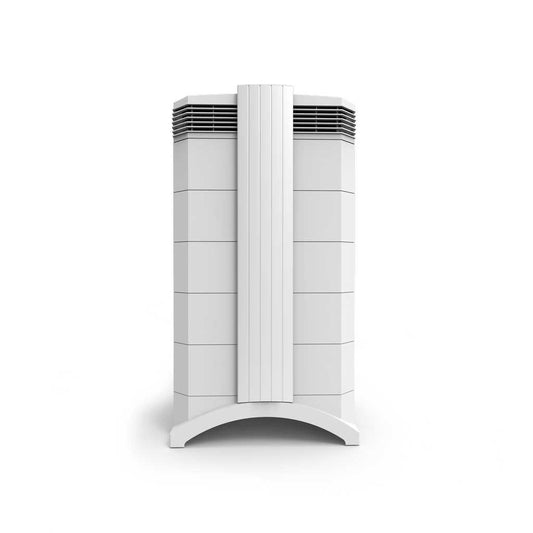
- Use a good allergy air purifier in your home
- Clean your bedding, carpets and furniture with high quality allergy cleaning products
- Minimise allergen ‘reservoirs’ like carpets, sofas and curtains
- Keep your home dry - this reduces mould as well as house dust mites
Allergen avoidance has to be done holistically, but the investment will pay off in terms of reduced symptoms, improved health and a better quality of life.
See our entire range of Dust Mite Relief Products
Top Dust Mite Relief Products per Category:
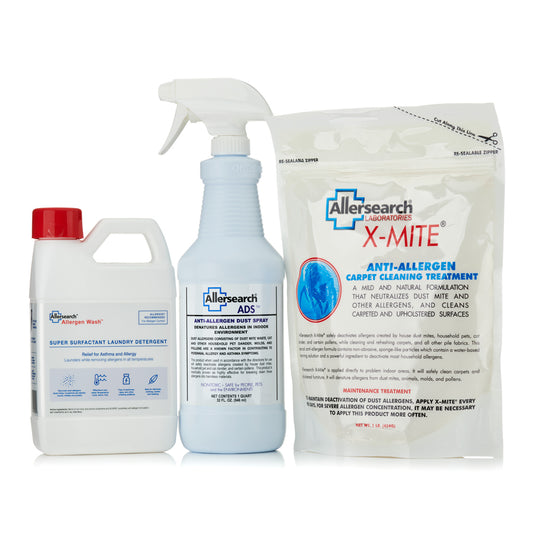
Dust Mite Free Home Package
The Dust Mite Free Home Package includes the key cleaning products for eliminating dust mite and dust mite allergens in your home. The package consists of the most popular Allersearch products, including the award winning Allergen Wash. Dust Mite Free Home
Allergen Wash
Allersearch Allergen Wash is an all in one laundry detergent that cleans bedding and all other fabrics while safely and effectively removing dust mite allergens in any water temperature. Besides dust mite allergens, the Allergen Wash also destroys pet dander, pollen and mould on contact. Laundry Detergent
Blueair 450E
The Blueair 450E air purifier is a great unit for anyone with dust mite allergies and for those who want to have a unit that is ultra quiet. The Blueair 450E is one of Blueair's best sellers and is ideal for medium to large rooms. A remote control and digital display provide extra convenience.
Blueair 450E
Blueair 650E
The Blueair 650E is the largest air purifier in the Blueair range. It moves the most air and is therefore ideal for large to very large rooms. The filtration technology that Blueair units use is ideal for dust mite allergens, as well as all other common allergens such as pollen, mould and pet dander.
Blueair 650E
FAQ about Dust Mites:

- What are dust mites?
- What is a dust mite allergy?
- How common is dust mite allergy?
- Where do dust mites lurk in my home?
- What is the link between dust mite and humidity?
- How can I get rid of dust mites in my housework routine?
- How can I get rid of dust mites with home improvements?
- Should I use an anti-mite spray to get rid of house dust mite?
- Is dust allergy always a result of house dust mite?
What are dust mites?
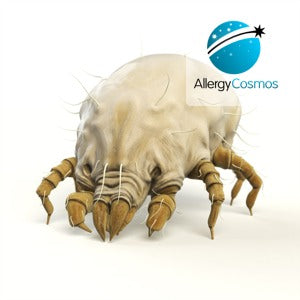
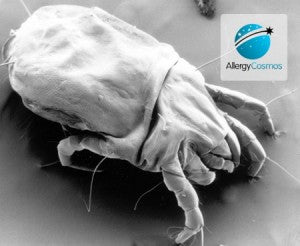
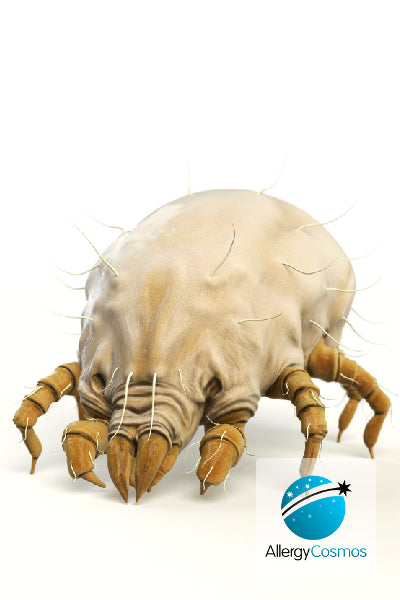
Dust mites (or House Dust Mites) are tiny (200-300 micron long) eight-legged creatures called arachnids and are closely related to the spider and the tick. They are found in every human habitation. There are two common species of house dust mite – the European house dust mite (Dermatophagoides pteronyssinus) and the American house dust mite (Dermatophagoides farinae). It is not dust mite itself which is the allergen, but digestive enzymes (proteins) contained in its droppings. The most important dust mite allergens are the proteins Der p1, Der p2 and Der p5. The whole droppings themselves are particles between 4 and 20 microns in size, but may crumble into smaller particles that can be as small as 0.5 microns across. House dust mites feed upon the skin scales shed by humans and other animals, found in house dust (hence their name). But dust mites don't bite or spread diseases. They are harmful only to people who become allergic to them. While usual household insecticides have no effect on dust mites, there are many ways to reduce exposure to dust mites in your home.
There may be many as 19,000 dust mites in one gram of dust, but usually between 100 to 500 mites live in each gram. Each mite produces about 10 to 20 waste particles per day and lives for 30 days. Egg-laying females can add 25 to 30 new mites to the population during their lifetime.
What is a dust mite allergy?
The house dust mite allergen is one of the most potent triggers of allergic reactions like rhinitis (running eyes, sneezing), asthma (wheezing, breathing difficulties) and childhood eczema. As with other allergens, dust mite allergen causes an ‘over-reaction’ in an allergic person. Immune molecules known as Immunoglobulin E are produced and these cause the release of an inflammatory chemical called histamine from mast cells (a type of immune cell). It is histamine that produces the characteristic symptoms of an allergic reaction. A non-allergic person’s immune system will not produce this reaction on exposure to allergens in pollen.
How common is dust mite allergy?
House dust mites are the most common cause of allergy symptoms in the UK.
Where do dust mites lurk in my home?
Dust mites favour bedding, mattresses, soft furnishings, soft toys and, to a lesser extent, carpets. The moisture and warmth produced by your body during sleep add to the problem – making the bed an ideal environment for coming into contact with house dust mite allergen. It is also easy to disturb dust mites. Walking across a carpet, getting in and out of bed or turning in bed will stir up a cloud of house dust mite and its allergen.
What is the link between dust mite and humidity?
To survive, house dust mites absorb water from the air (they don’t actually drink) and when humidity is less than 50% they tend to dry out and die. They also prefer temperatures about 70°F (21°C). It is crucial to get rid of damp in your home and to use background heating if necessary. Ventilate by opening windows, and check for condensation in the kitchen and bathroom. If you live in a humid area, consider buying a dehumidifier (however, be aware that very dry air can be uncomfortable especially if you have sinus or respiratory problems). An air purifier is a good solution, because it creates air movement that helps combat humidity, and at the same time it captures dust mite and other allergens out of the air.
How can I get rid of dust mites in my housework routine?
- Wash soft toys and bed linen weekly with the laundry detergent Allergen Wash from Allersearch – it destroys natural allergens such as dust mite allergen and pollen on contact. Allersearch Allergen Wash Laundry Detergent can be used with cold, warm or hot water, because it has an active ingredient in it that destroys the allergen on contact. If you wash your laundry with a regular detergent, note that a cooler wash will only get rid of some of the allergen and the skin scales the mites feed off.
Always make sure bedding is completely dry before putting it back, because mites will flourish in the presence of any trace of dampness. - Consider washing clothes, which bring mites in from outdoors, with the mite-killing detergent Allergen Wash too. Make sure there is no damp in the wardrobe.
- Curtains, pillows, and duvets will need a good wash every few months as well.
- Vacuum floors, rugs or carpet with a vacuum that is fitted with a HEPA filter and that is leakage free.
- Use a good allergy air purifier to clean the air.
- Wipe down all furniture surfaces with a damp (but not wet) cloth each day and use an allergy dust spray such as the ADMS from Allersearch.
- Make your dusting routine as thorough as you can – don’t forget to go behind/under furniture, along skirting boards and picture rails, and anywhere else that dust might collect.
- Try adding a bit of eucalyptus oil to your duster, as this deters mites. There are also ‘anti-mite’ electrostatic dusters which hold onto the dust rather than spreading it around.
These efforts have to be continuous, rather than a one-off, because you can never eradicate house dust mite from your home for good, as new ones are always being brought in on people’s clothes. However, with a good air purifier you will limit your exposure to the allergens, and with the use of the Allersearch line of Cleaning Products you will quickly limit the number of mites in your home.
How can I get rid of dust mites with home improvements?
- Get rid of any clutter, like piles of newspapers and books, where more dust can build up. Put ornaments into glass cabinets rather than on open shelves.
- Consider replacing upholstered sofas and armchairs with leather or vinyl covered furniture, which house dust mite cannot penetrate.
- Similarly, you could perhaps replace carpets with wooden or vinyl flooring.
- In bedrooms (prioritise those of people with allergies) start afresh with a new mattress, duvet, and pillows and cover with mite-allergen proof covers (research has shown this does improve asthma in children allergic to house dust mite and these covers are probably the best investment you can make in tackling house dust mite).
- When choosing a new bed, remember that a raised bed makes cleaning underneath, where dust collects, so much easier. Padded headboards are dust traps, and a slatted base is good because it will encourage circulation of air around the bed.
- Replace curtains, which gather dust, with blinds.
- Seal up any cracks between boards on the floor so that dust does not come up from the space below the floorboards.
- Keep walls simple – no picture rails, no clutter on ledges.
These measures will create an entirely new environment which could seriously reduce the house dust mite burden in your home.
Should I use an anti-mite spray to get rid of house dust mite?
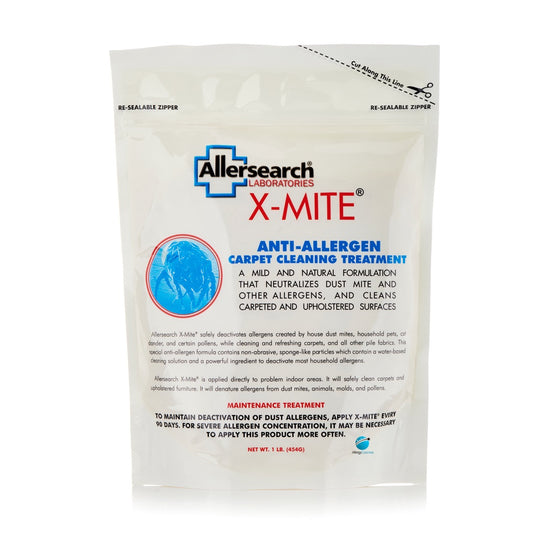
Using an anti-mite spray is an important part of your regular cleaning routine. A spray can penetrate mite reservoirs in carpets, for soft furnishings and mattresses we recommend using the X-Mite Powder Carpet Cleaner from Allersearch. It is a dry powder that helps to get rid of mites where they nest. Be careful to use cleaning products with natural ingredients, spraying a chemical, especially on a regular basis, may create problems for those with Multiple Chemical Sensitivity and is certainly not recommended if there are young children around.
Is dust allergy always a result of house dust mite?
Although house dust mite is the most common cause of dust allergy, it is not the only one. Dust allergy may also be due to mould spores or pet dander.
Links
Advice from the American College of Allergy, Asthma & Immunology http://www.acaai.org/allergist/allergies/Types/dust-allergy-information/Pages/default.aspx
Dust Mites Articles
Living with Dust Mite Allergies
Dust mites live in mattresses, pillows, comforters, carpets, blankets, curtains and upholstered furniture. They are present in more or less every household. Due to their fertility, up to 1,000,000 living dust mites can inhabit one single bed, in addition to millions of dead ones.
Allergic to un-wanted Bed Partners?
Allergens produced by house dust mites are one of the most common causes of asthma with up to 85% of asthmatics being allergic to the miniscule mites. As well as asthma, allergic reactions to the mite include sneezing, itching, inflamed eczema, running nose and watery, red eyes. The bad news is that the house dust mite thrives in the indoor environment provided by modern homes, especially in the bedroom where they...
Dust Mite Allergies & How to Fight Them

The house dust mite is one of the most potent and common triggers of allergic reactions like hay fever symptoms (running eyes, sneezing), asthma (wheezing, breathing difficulties) and childhood eczema. House dust mites are tiny (200-300 micron long) eight-legged creatures related to the spider and they are found in every human habitation. There are two common species of dust mites - the European house dust mites (Dermatophagoides pteronyssinus) and the American house dust mite (Dermatophagoides farinae). It is not dust mite itself which is the allergen, but digestive enzymes (proteins) contained in its droppings. The whole droppings themselves are particles between 4 and 20 microns in size, but may crumble into smaller particles that can be as small as 0.5 microns across.
How to kill dust mite?
Know your enemy! Here are some important facts about house dust mite which you can use to help rid your home of this pest.
- The fight is endless - dust mites are everywhere and even if you were able to get rid of all of them in your home, new ones would still appear (they are carried into your home on people’s clothing, for instance). So look for long-term solutions which will reduce your HDM burden.
- Dust mites are found mainly in bedding, soft furnishings and, to a lesser extent, carpets. It is easy to disturb them - getting into and out of bed, for example - and throw up a large cloud of allergen which tends to stay near the source, rather than float in the air.
- House dust mites feed on the dead skin in household dust.
- Mites prefer humid conditions. To survive they absorb water from the air and when humidity is less than 50% they tend to dry out.
Here are some good tips for keeping house dust mites under control.
- If you are thinking of doing some serious home improvement, think about replacing upholstered sofas and armchairs with leather or vinyl covered furniture, which house dust mites cannot penetrate. Consider replacing carpets with hard flooring. This will create an entirely new environment which could seriously reduce the dust mite burden in your home.
- Tackle dust mites in bedding - start afresh with a new mattress and pillows and cover these with mite-allergen proof covers (research has shown this does improve asthma in children allergic to house dust mite). Wash bedding regularly with allergy friendly laundry detergent such as Allergen Wash from Allersearch.
- Damp dust everywhere regularly to get rid of the house dust mite source of food. Use an effective allergy dust spray such as ADS or ADMS from Allersearch, it will destroy the allergy symptom causing protein on contact. Get rid of any clutter where more dust can build up.
- It is crucial to get rid of any dampness in your home. Ventilate by opening windows, and check for condensation in the kitchen and bathroom.
How to get rid of dust mite allergens?
Killing dust mites by lowering humidity and removing dust will not automatically remove dust mite allergen in your home, although over time the amount is sure to decrease because you have tackled it at the source. The allergen will still persist in bedding, soft furnishings and so on. Therefore, tackle these reservoirs of allergen. Vacuum (we recommend Miele), use a good air purifier (ideally IQAir), dust with an allergy friendly cleaning product, and wash laundry with Allergen Wash to remove as much allergen as possible.
The Secret Life of Dust
I've been reading a brilliant book on, of all topics, house dust! Hannah Holmes "The Secret Life of Dust" raises some questions of importance to those whose asthma is triggered by allergens like house dust mite. We knew that house dust is a complex mixture of particles of both chemical and biological origin, but I had no idea just how mysterious this substance actually is.
Holmes describes an intriguing complex called 'The Personal Cloud' which came to light in house dust experiments carried out in the 1990s. A group of 178 participants based in California were wired up to personal dust monitors, which they wore for 12 hours at a time as they carried out their usual activities. The scientists, from the US Environmental Protection Agency, also monitored indoor and outdoor air for dust. The results showed that the personal dust monitors registered much higher levels of dust than the external measurements – in other words, the individuals were actually emitting dust themselves. That's where the idea of the personal cloud comes from. Lance Wallace, one of the EPA team, noted that the personal cloud accounts for a large amount of the dust in your home.
So what does this invisible cloud actually consist of? Skin flakes were the major known component. In 12 hours, the dust monitor collected 150,000 to 200,000 skin flakes per individual. In fact that's just a small percentage of the skin we shed from the epidermis every day. The total amount shed is about 50 million scales which, as we know, is the prime diet of house dust mite, whose droppings contain the potent allergen dreaded by asthmatics everywhere. Most of this skin flake burden gets rinsed off when you bathe or shower. And, according to Wallace, you breathe in 700,000 skin flakes per day while the rest sinks into the carpet, your bed, or your furniture. These skin flakes amount to around 10% of your personal dust cloud.
Another component is lint – the tiny fibres emitted from your clothes. But, again, this amounts for only a minor proportion of the personal cloud. The rest of its components are still unknown. However, Wallace's team carried out further experiments which did shed some light. He wired up his own house with dust and gas monitors and found how they spiked each weekday morning with a cloud of car exhaust – even though the road was over a mile away. So the monitor network was very sensitive to any dust-generating activity.
One day Wallace accidentally waved his arm towards a monitor and noted how it recorded a sudden dust flurry. A colleague was unable to reproduce this effect and it turned out that this man had his shirts laundered and wrapped in plastic till he put them on. Wallace's shirts were home-laundered and hung in the wardrobe, collecting dust particles ready to be emitted when he moved his body (that is what the dust monitor picked up when he waved his arm). Even working quietly at a computer will multiply dust levels in a room. It'll be interesting to learn what the other components of the personal dust cloud are, and whether they are allergens. In the meantime, get a grip on the house dust by dusting, vacuuming with a leakage free HEPA vacuum cleaner and using a high grade air purifier.
http://www.time.com/time/health/article/0,8599,1966870,00.html
Anti-Allergen Bedding - does it work?
House dust mite allergen is a potent trigger of asthma and allergic rhinitis, causing symptoms like wheezing, coughing, streaming eyes, and sneezing. The culprit is not the mite itself, but proteins found in its droppings. The main allergens are the proteins known as Der f1 and Der p1. The key to managing allergic disease is allergen avoidance. If you are not exposed – or are exposed less often - then you can become less dependent upon medication.
But what is the best way to reduce the burden of house dust mite allergen in your home? The following measures are most often recommended:
- The use of mite allergen-impermeable mattress covers
- Installing a leakage free air purifier in the bedroom with enough power to clean the room at least twice an hour
- Intensive and regular damp dusting
- Using fragrance free and allergy friendly cleaning products
- Vacuuming with a leakage free vacuum fitted with a High Efficiency Particulate Air (HEPA) filter
- Improving ventilation and keeping humidity low
But which method of allergen avoidance is the most effective – and should you do just one thing, or several things at the same time? Two new scientific papers in the journal Allergy may help point you in the right direction.
Researchers at Utrecht University have used participants in the Prevention and Incidence of Asthma and Mite Allergy (PIAMA) study to look at the effect of mite allergen-impermeable mattress covers (or Anti-Allergen Bedding as they are often called) on levels of house dust mite allergen and the development of sensitization and allergic symptoms during the first eight years of life, with annual follow up. Nearly 900 pregnant women, already known to be allergic, received either mite allergen-impermeable polyester-cotton mattress and pillow covers, or ordinary equivalent cotton bedding. The Anti-Allergen Bedding and the regular bedding were used to cover the parents’ and the baby’s bed. They weren’t told what kind of bed cover they had till after the study was over.
The parents gave information about any allergic symptoms in their child every year till they were eight years old. The researchers also took dust samples to analyse for Der f1 and Der p1 when the children were three months old and a second lot of samples when they reached the age of eight.
There was a temporary decrease in asthma symptoms at the age of two years among those who used the mite-proof covers and lower levels of Der f1 (but not Der p1). Overall, however, the mite-proof covers alone did not have any protective effect. In fact, those using the mite-proof covers were even more likely to develop eczema than those using pure cotton. The researchers were surprised to find this and they believe the increased risk of eczema might be because children sweat more when using mite-proof bedding.
This study’s findings are different from others, which have found that Anti-Allergen Bedding is protective against asthma and allergy. The researchers point out that the difference is that allergy friendly bed covers were only one element in an allergy avoidance campaign in these others studies. Other common measures were also used. So the take-home message is that the key to effective allergen avoidance is taking a multi-pronged approach.
Meanwhile, a review of the scientific evidence on house dust mite avoidance in perennial allergic rhinitis found only nine clinical trials covering 500 participants (the one study from The Netherlands mentioned above involved nearly twice that number). These looked at mite-proof bedding, chemicals that kill mites (acaricides), HEPA air filters, and a combination of these approaches. All studies agreed with the Dutch study that mite-proof bedding alone is not enough for effective allergen avoidance.
Infographics - Where Does the Air Pollution in Your Home Come From?
Here you can find out what pollutants and allergens can effect you and your family in your home. Feel free to add this Infographic to your website or blog, as long as you retain the embeded code to recognize Allergy Cosmos. You can find the code to embed this infographic into your site below.
If you want to protect yourself from air pollution or are looking for the best allergy relief products visit us at Allergy Cosmos.
Embed Code:
<div style="width: 629px; height: 839px; position: relative; padding: 0px; float: left;"><img title="Air Pollution in Your Home" src="http://www.allergycosmos.co.uk/media/wysiwyg/Pollution_In_YOUR_Home_AllergyCosmos.png" alt="Air Pollution in Your Home" width="629" height="839" /></div><p> </p><a title="Air Pollution in Your Home" href="http://www.allergycosmos.co.uk/" target="_blank"></a><div style="position: relative; font-size: 10px; font-family: arial,sans-serif; font-weight: normal; clear: left;">If you want to <a href="http://www.allergycosmos.co.uk/indoor-air-pollution">protect yourself from air pollution</a> or are looking for <a href="http://www.allergycosmos.co.uk">the best allergy relief products</a> visit us at Allergy Cosmos.</div></div>
Hardwood Floors to Improve Allergy Symptoms

I am having the 25-year old carpet in my home office removed and am thinking about putting in hardwood floors to improve allergy symptoms. This is a refurbishment job that is obviously well overdue. I discussed the replacement options with Tony, who is doing the work and knows about floors, and we came up with a number of options – namely:
- Natural hardwood
- Laminate
- Tiles
- Stone
- Vinyl
- Lino
- Cork
Or the cheapest option - varnishing the floorboards of the room, once these are revealed and if they are in good condition. To be fair, some of the above options are not really practical for a small home office but I’ve included them just to give you a feel for the choices available. What I’m not doing is going for a new carpet. Here is why. From an Allergy Cosmos point of view, carpet is the unhealthiest floor covering you can have. It contains 100 times more allergens than a hard floor, with one square metre of carpet typically trapping 67 grams (about two ounces of dust). Carpet is a reservoir for the following allergens and other troublesome substances:
- Pet dander
- House dust mite
- Bacteria
- Mould spores
- Dirt from outside, brought in on shoes, which will include pollen
Carpet is warm and moist (especially if a spill has not been properly cleaned up) and thus an ideal breeding ground for the house dust mite that feeds off the dust present there. The fibres of a carpet attract dust and while there is a school of thought that says carpet is good because it traps allergens and stops them being airborne, it is in fact all too easy to stir up the dust and other noxious stuff as you tread across the carpet. And what about toddlers who spend a lot of time crawling on the floor – they are directly exposed to the allergens that are present in a carpet.
However, although hard floors are growing in popularity, wall-to-wall carpet is still present throughout many homes. If you are stuck with your carpet – or want to keep it – but have an allergy, you can have an action plan to keep it relatively allergen-free:
- Vacuum – not occasionally but at least once or twice a week (daily, if you can find the time).
- Use a good quality vacuum cleaner that is leakage free. Consider upgrading to a machine fitted with a high efficiency particulate air (HEPA) filter, which will trap a high proportion of allergens.
- Many vacuum cleaners leak and disperse dust all over your room instead of trapping them in the bag. If it’s not leakage free, replace it.
- Vacuuming, on its own, is not enough to keep the carpet clean. Regular washing, dry cleaning and stem cleaning are essential.
Carpet does have some advantages. It is relatively cheap, provides good insulation against sound and heat and it is comfortable (many people just like the feel of it under their feet). So you may decide to buy a new carpet instead of investing in a hard floor. People with allergies might want to consider the following guidelines:
- Short, tightly-woven pile traps less allergen that long loose pile.
- Wool and natural fibres are better than synthetics, except that nylon is said to repel allergen deposit.
- Rugs with hard flooring are a good compromise – a cotton-based rug can be washed regularly. Coir, sisal, sea grass are other good natural rug options.
- New carpet often contains Volatile Organic Compounds (VOCs) including formaldehyde, which can cause allergy symptoms and Multiple Chemical Sensitivity (they are responsible for the ‘new carpet’ smell that’s often very evident in a new or refurbished office). The VOCs can ‘outgas’ for a number of weeks or even months, so it is advisable to ‘air’ the carpet before laying it down, if at all possible.
- It is not just the carpet which may cause problems. A foam backing may emit formaldehyde so it is better to go for a hessian, felt, or jute (all natural) backing. Glues used to fix the carpet to the floor may also be a source of VOCs so mechanical fixing is preferable.
- There are anti-allergy carpets, which are coated with antibacterial substances. House dust mite needs bacteria to process skin flakes before they can feed on them. Therefore, killing bacteria will reduce house dust mite levels but it is not known how good an anti-allergy carpet is at reducing allergy symptoms.
However good your choice and carpet care is, in reality it is very hard to keep allergen levels in a carpet down and you will be living with a constant source of trigger for your condition (especially if the carpet is in the bedroom). So why not follow the advice of the Asthma and Allergy Foundation of America – if you have a severe allergy, replace your carpet with hard flooring? By the way, in case you're still having trouble making up your mind whether or not to ditch the carpet, Tony tells me he found a big family of 'carpet bugs' lurking under mine when he ripped it up. That convinced me that I'd done the right thing!


Loading...